
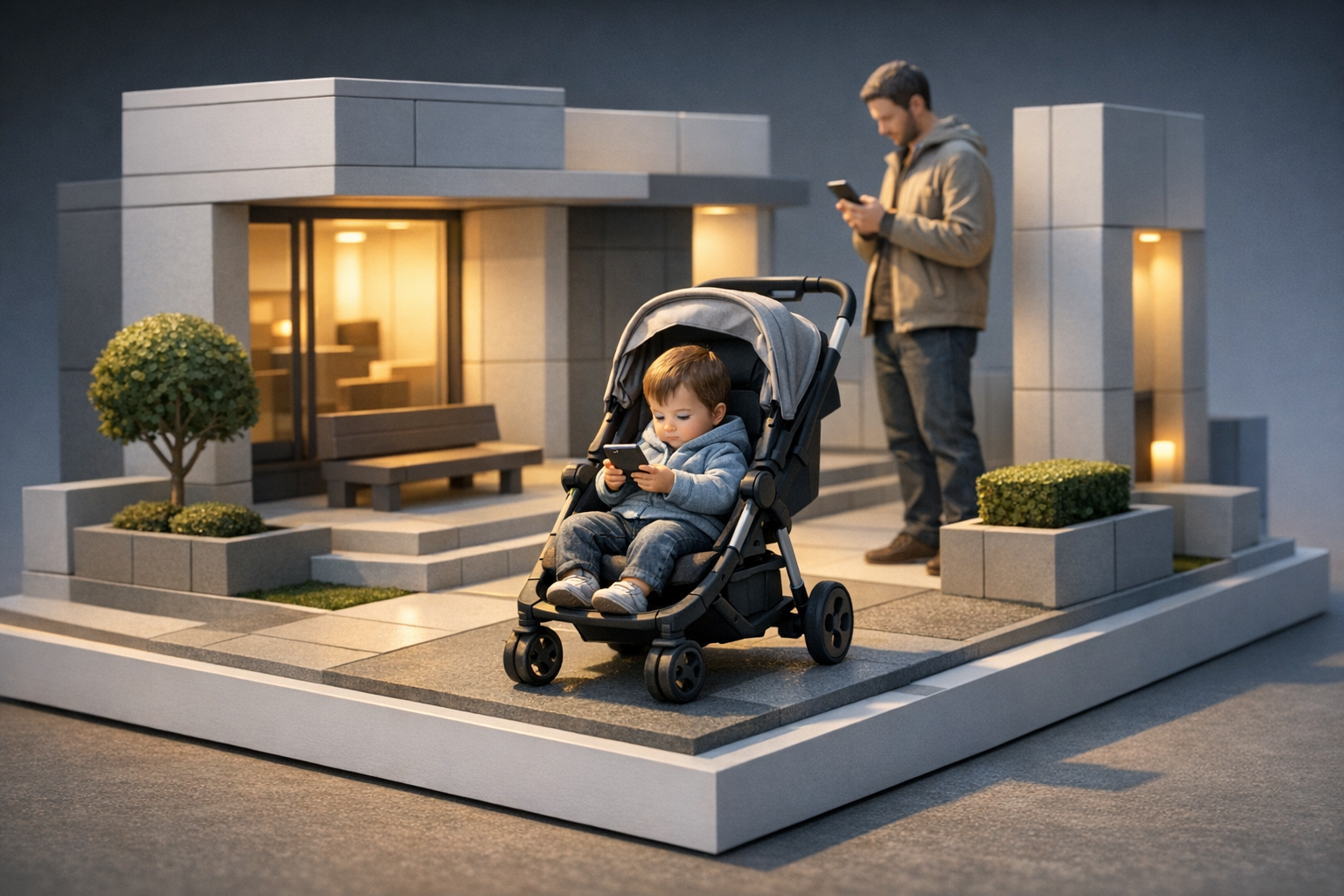
I saw something the other day in a shopping centre that stayed with me. Not in a judgemental way, but in that curious, reflective way that teachers often do when something does not quite sit right. A child, no older than three or four, sat in a pushchair. In front of them, a phone. On the screen, a stream of videos from TikTok and Instagram Reels. Each clip lasted no more than five or ten seconds. Swipe - new video - swipe again - another one. Bright colours, loud sounds, fast cuts. No pause, no interaction, no conversation.
The parent stood nearby, scrolling on their own device. In many ways, this detail felt just as significant as the screen in front of the child. Because what is also being observed in that moment is behaviour itself. A child is not only consuming content, but also learning what ‘normal’ looks like. If attention is constantly directed away from face to face human interaction and towards a personal device, that becomes part of the child’s understanding of how we engage with the world.
A Different Kind of Attention
Screens have been part of family life for years. I can remember long car journeys with a portable DVD player strapped to the back of a headrest, keeping my own children occupied. It gave us peace, it gave them something to watch, and it felt harmless, even helpful. But cartoons, even the simplest ones, have structure. They have a beginning, a middle, and an end. Characters develop, stories unfold, and problems are introduced and resolved. Children learn to follow a narrative, to anticipate, and to make sense of what they are seeing. Over time, they learn to stay with something and see it through.
There is also something important about the way animated characters are designed. As highlighted in research exploring children’s media preferences, animated characters are often intentionally created to be highly relatable. Whether it is a talking animal, a superhero, or a curious child, these characters tend to embody traits and experiences that children can easily connect with. In simple terms, it helps them make sense of the world through familiar, emotionally accessible figures. Alongside this, many cartoons also carry clear moral messages and help children develop an understanding of emotions, relationships, and consequences in a way that is accessible and developmentally appropriate.
Short-form social media content works in a very different way. It is fragmented, rapid, and designed to capture attention instantly or lose it within seconds, often doing the exact opposite of what cartoons achieve. Rather than featuring familiar, stable characters or structured narratives, it frequently relies on isolated clips, sudden humour, shocking moments, or attention-grabbing stunts that exist outside of any meaningful storyline. There is rarely any sustained character development, moral framing, or emotional journey for children to follow or learn from in a coherent way.
What Is Being Lost
When children are repeatedly exposed to rapidly changing stimuli, something subtle begins to shift. They become accustomed to constant novelty. Attention starts to feel conditional, dependent on immediate stimulation and rapid reward. Over time, this limits opportunities to develop sustained focus and attention. When that same child enters a classroom, the contrast is clear. Reading a paragraph, listening to instructions, working through a problem, or staying with a task all require a different kind of focus entirely.
Teachers across phases are already noticing this in the reduced attention spans, the increased need for prompts, and the difficulty sustaining engagement when tasks become challenging or less immediately stimulating. This is not simply about motivation. It is about what attention has become used to and how society is re-wiring children’s brains from a very early age.
The Human Element
There is another layer to this that is easy to overlook. Children do not just need content, they need interaction. They need eye contact, facial expressions, and spoken language directed at them, as well as the back-and-forth of conversation, even in its simplest form. A smiling face, a raised eyebrow or even a frown. A response that comes from another human that shows them they are important, cared for and not forgotten.
When children spend large amounts of time consuming content designed by adults, for adults, without interaction, those experiences become less frequent. They are not playing in the same way, not exploring in the same way, and not engaging socially in the same way.
This Is Not About Blame
It is important to say this clearly. This is not about criticising parents. Most are doing their best in a world that is busier, louder, and more demanding than ever. Devices offer convenience, relief, and sometimes a much-needed moment of calm in the middle of a chaotic day. We have all relied on different forms of distraction at different points. What matters here is awareness. Understanding that not all screen time is equal, and that passive consumption is not the same as meaningful engagement.
Why This Matters for Schools
What happens beyond the school gate does not stay there. It walks into our classrooms every day, shaping how children approach learning, attention, and persistence. If children are becoming used to a world where content changes every few seconds, where effort is optional, and where engagement is driven by instant appeal, then schools are working against a powerful current. That does not mean we respond by competing with that environment. If anything, it suggests the opposite. We need to protect attention, develop stamina for thinking, and create spaces where children can engage deeply, even when it is not immediately rewarding.
A Final Thought
I keep coming back to that image in the shopping centre, a child quietly absorbing a stream of content designed to capture attention but not hold it. It is easy to see it as a one-off moment, but more worrying when you recognise it as part of something much bigger.
As teachers, we often focus on what is directly in front of us, the lesson, the task, the behaviour, the outcome. Increasingly, however, what we see in classrooms is being shaped elsewhere. Attention is not what it used to be. Focus needs to be taught, modelled, and protected, and the ability to stay with something, even when it becomes difficult or slow, is no longer something we can assume. That has implications for all of us, not in how we compete with the noise, but in how we intentionally create something different. Something calmer, more sustained, and more human.
Because if children are growing up in a world where everything changes every few seconds, then the ability to pause, to think, and to truly engage may become one of the most important things we can help them develop.
