
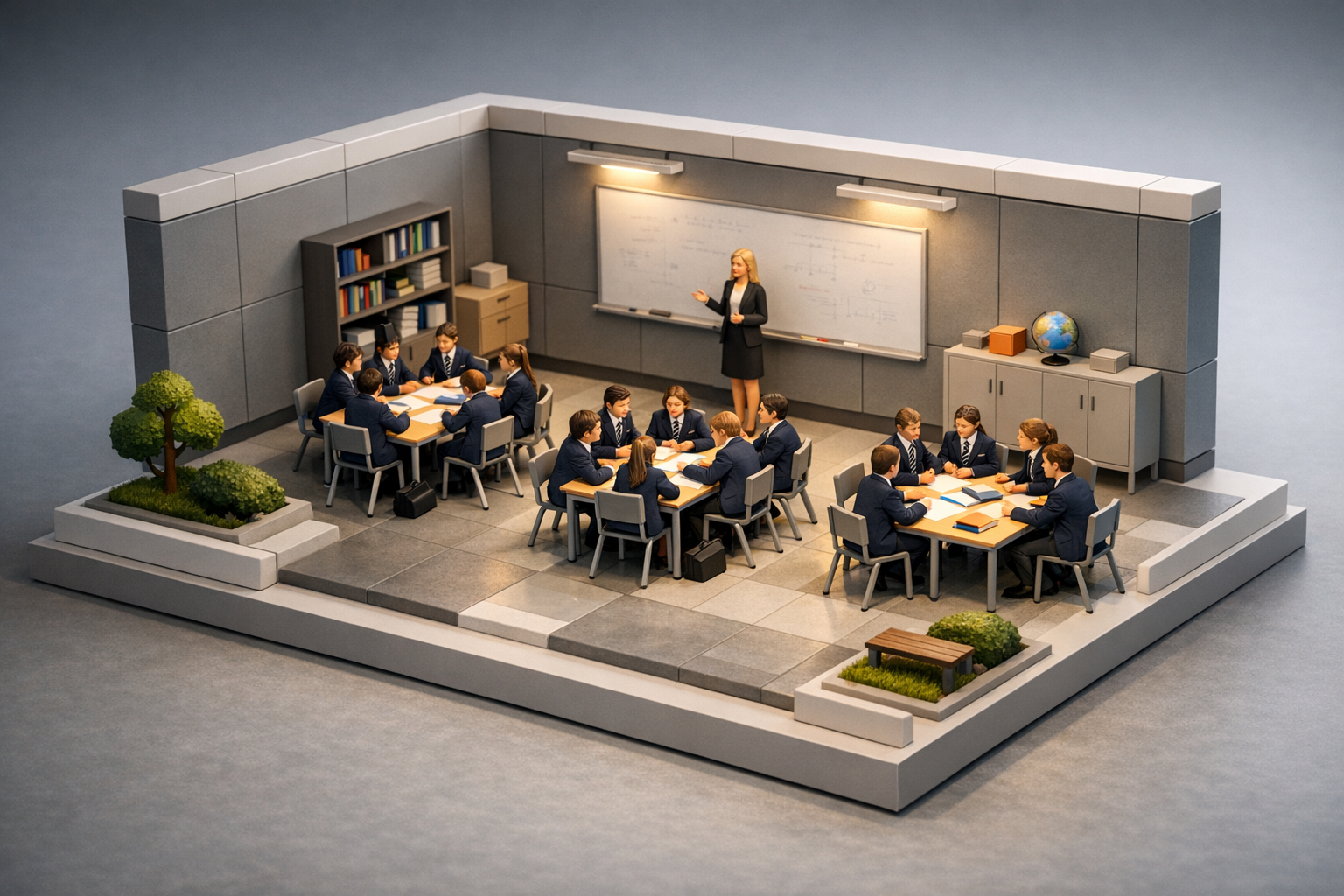
Walk into enough classrooms and you'll see a familiar scene. Students are sat in groups discussing a task. One student is leading the conversation, another is contributing occasionally, while one or two others are quietly sitting there, seemingly engaged but contributing very little. At first glance, it looks like learning is taking place. The classroom feels busy, students are talking and collaboration appears to be happening. However, if you spend enough time observing these situations, a different picture often emerges.
In my experience, groupwork is one of the most poorly designed and poorly implemented approaches in many classrooms. That is not because teachers deliberately get it wrong. Rather, it is because effective groupwork is much harder to design than many people realise. Simply putting students into groups does not automatically create collaboration. More often than not, it simply creates opportunities for some students to contribute heavily while others sit back and enjoy the ride.
The Passenger Problem
One of the biggest challenges with groupwork is that students rarely contribute equally. In most groups, somebody naturally assumes the role of leader. They organise the task, direct the discussion and make decisions about what happens next. While this can sometimes be helpful, it also means that other members of the group can become increasingly passive. The more dominant personalities often shape the direction of the discussion, while quieter students contribute less frequently or not at all. This might mean the loudest ideas come to the forefront, not necessarily the best.
This creates a second problem. When some students are allowed to become passengers, the cognitive challenge of the task is significantly reduced. Instead of every student wrestling with the content, generating ideas or solving problems, a proportion of the group simply relies on others to do the thinking for them. Although four students may be sitting around a table, you are rarely getting four students' worth of thinking. In fact, you are often getting far less.
The reality is that groupwork can sometimes become a mechanism for hiding rather than participating. Most teachers can identify the students who have mastered this skill. They contribute just enough to appear involved, but not enough to meaningfully advance the group's thinking. At the end of the task, they benefit from the work produced by the group despite investing very little effort themselves.
Activity Does Not Equal Learning
Part of the reason groupwork remains popular is that it creates visible activity. Students are talking, sharing ideas and engaging with one another. From a distance, this can look like a highly successful learning experience. However, activity and learning are not the same thing.
As teachers, we are interested in what students are thinking, not simply what they are doing. This is where individual work often has a significant advantage. When students work independently, there is nowhere to hide. Every learner has to process the information, generate their own ideas and commit their thinking to paper. This provides a much clearer picture of what they know, understand and can do.
Individual work also tends to increase accountability. Students cannot simply ask a more knowledgeable peer for the answer or rely on somebody else to complete the difficult parts of the task. They have to engage with the challenge themselves. For this reason, I often find myself asking a simple question when observing lessons: what educational value is the groupwork adding that individual work would not? If there is no clear answer, then independent work may well be the better choice.
The Importance of Task Design
None of this is an argument for removing groupwork from classrooms. There are many situations where collaboration can add genuine value to learning. Students may need to combine different sources of information, tackle a complex problem from multiple perspectives or work together to create something that would be difficult to achieve individually. In these situations, collaboration can strengthen learning and improve outcomes.
The key point is that groupwork should be chosen because it enhances the task, not simply because it offers variety or because students enjoy working with their friends. Too often, groupwork becomes the default option without enough consideration being given to whether collaboration is actually necessary. Effective teachers are highly selective about the tasks they choose and have a clear rationale for why those tasks are being used.
This is why task design matters so much. If students are going to work collaboratively, every member of the group needs a clear role and a clear responsibility. Without that structure, the passengers inevitably emerge and the quality of thinking begins to decline.
Group Goals and Individual Accountability
Dylan Wiliam captures this challenge particularly well through two important principles: group goals and individual accountability. He argues that students should be "working as a group, not merely working in a group." In other words, there should be a shared goal that genuinely requires collaboration rather than simply placing students together while they complete separate pieces of work.
Alongside this, Wiliam argues that "individual students cannot be carried along by the work of others." Every student must contribute to the success of the group and every student must remain accountable for their own learning. These two principles address many of the weaknesses that commonly undermine groupwork. Without a meaningful group goal, students simply divide the task and work independently. Without individual accountability, some students quickly discover that they can sit back and allow others to do the heavy lifting.
When both principles are present, however, groupwork becomes much more powerful. Students understand that the group depends on their contribution and that their own success depends upon active participation.
Practical Ways to Increase Accountability
One reason cooperative learning approaches such as Kagan structures have remained popular is that they deliberately build accountability into collaborative tasks. While teachers do not need to adopt an entire programme, there are several useful ideas that can strengthen groupwork.
Some examples include:
➤ Numbered Heads Together: Every student must understand the group's answer because anyone can be selected to explain it.
➤ Think-Pair-Share: Students think independently before discussing their ideas with a partner.
➤ Round Robin: Students take turns contributing, preventing one individual from dominating the discussion.
➤ Jigsaw Activities: Each student becomes responsible for a specific piece of information that the group needs.
The common thread running through these approaches is that they make participation difficult to avoid. Every student has a role, every student has a responsibility and every student is expected to contribute to the group's success.
Final Thoughts
The question is not whether groupwork is good or bad. The more important question is whether collaboration genuinely improves the learning taking place. Too often, groupwork creates opportunities for some students to think while others simply observe. When that happens, learning suffers because the cognitive challenge of the task has been reduced.
However, when group goals are clear, individual accountability is built into the design and collaboration adds something that independent work cannot, groupwork can be incredibly effective. The challenge for teachers is therefore not whether to use groupwork, but when to use it and how to design it well.
If we are going to ask students to work together, there should be a clear educational reason for doing so. Otherwise, we may simply be creating opportunities for a few students to do the thinking while everyone else enjoys a comfortable session of groupwork and chill.
